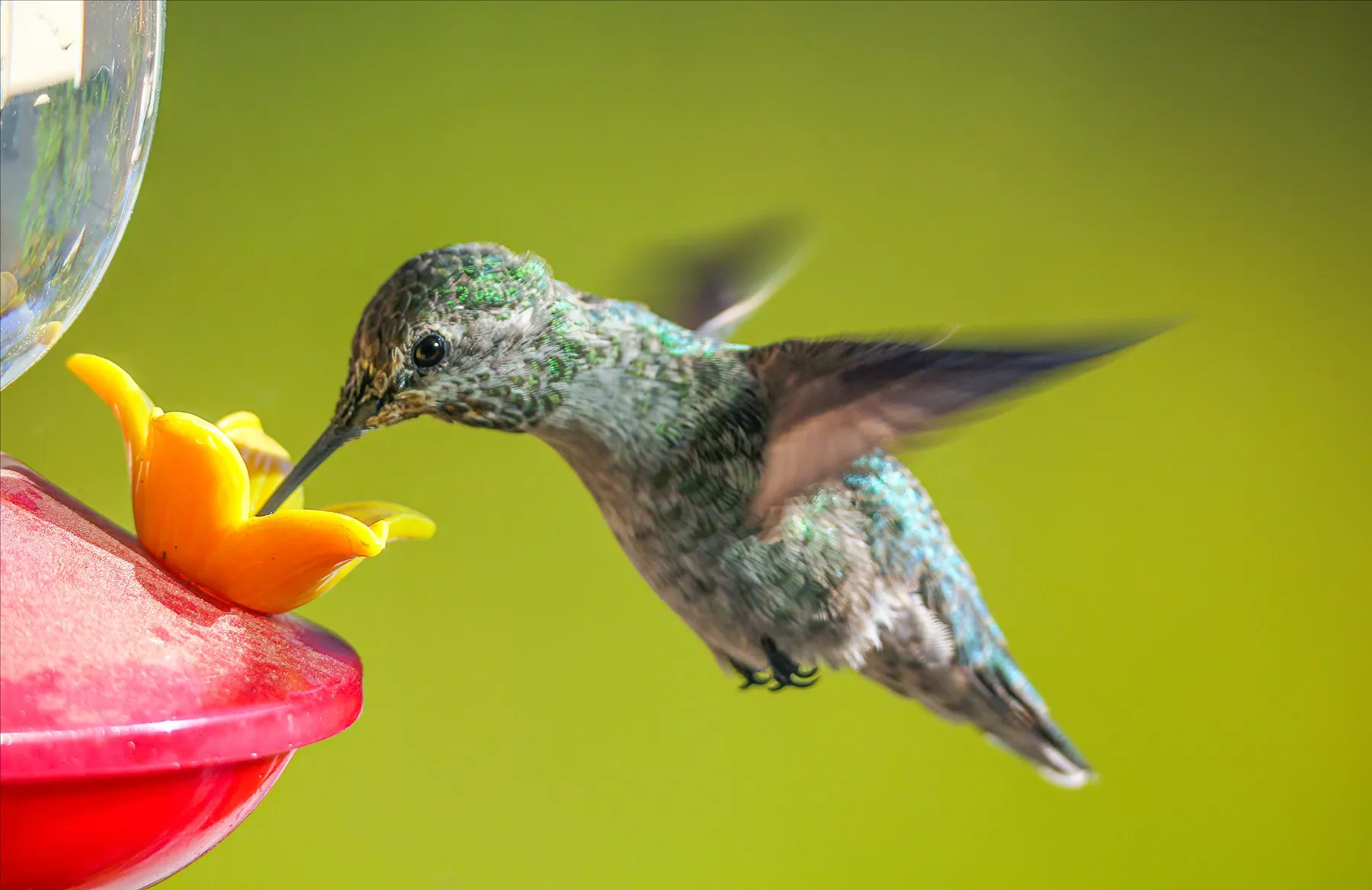
Quick answer: Hang a hummingbird feeder where birds can see it from the air, people can reach it without a ladder, and the nectar stays out of strong afternoon heat. Partial shade is useful, but the feeder should not be hidden inside dense foliage. Treat nearby glass with effective exterior markings or screens; do not rely on feeder distance alone to prevent collisions.
Start with the birds’ view
A feeder is easier to discover when it is visible from open airspace and from nearby perches. Hummingbirds often inspect a yard from a branch, wire, or shrub before crossing to a feeder. A position near flowers or a small perch can help, but do not bury the feeder in vegetation where cats or other predators can wait unseen.
The best location is usually a bright edge: near a garden or shrub line, with an open approach and some cover nearby. Avoid a completely exposed pole in the middle of a lawn and avoid a dark corner where the feeder is difficult for both birds and people to see.
Use shade without making the feeder invisible
Direct, intense sun warms nectar and can make the feeder harder to maintain in hot weather. Morning sun with afternoon shade is a practical compromise. A covered porch, deciduous tree, or shaded side of a house can work if the feeder remains visible and accessible.
Cornell’s feeding guidance (opens in a new tab) notes that direct sun can make sugar water spoil sooner. Place the feeder where you can inspect it routinely; shade does not extend an unsafe batch of nectar indefinitely.
Shade is not a substitute for frequent inspection. Cloudy nectar, mold, insects, and a leaking port are reasons to clean and refill sooner, whatever the location.
Think carefully about windows
Window collisions are a separate risk from feeder placement. Cornell Lab guidance recommends making glass visible to birds with exterior markers or screens, and the placement of a feeder can affect how much speed a bird can build before reaching a window. Do not hang a feeder in a position that sends birds on a fast, unobstructed flight directly toward glass.
If a feeder is close to a window, make the window itself visible with an exterior pattern or screen. If it is farther away, treat the flight path as part of the yard’s safety plan and add effective exterior markers where needed.
Current Cornell window-safety guidance (opens in a new tab) emphasizes treating the outside of hazardous glass rather than relying on a supposedly safe feeder distance alone.
Leave room for cleaning
Place the feeder where you can remove it comfortably every few days in hot weather. You should be able to see the nectar level, inspect ports, and clean the whole feeder without stretching across a bed or climbing onto a chair.
Keep a small container or towel nearby so the routine is easy. A beautiful location that makes cleaning awkward will eventually become a neglected location.
Treat species and region as local questions
The Ruby-throated Hummingbird source is useful context for much of the eastern United States, not a claim that every U.S. hummingbird has the same seasonal pattern or habitat. Check a regional field guide or local bird organization for the species that actually occur where you live. The placement principle stays the same: visible approach, protected glass, manageable nectar, and a route you can clean.
Sketch the flight route before hanging
- Mark the open approach a bird can use.
- Identify a nearby perch or shrub that offers a pause without becoming a cat ambush.
- Treat any glass on the approach path from the outside.
- Confirm that you can remove the feeder from ground level for the next cleaning.
A small-yard placement checklist
- The feeder is visible from open airspace.
- Nearby shrubs or a branch offer a resting place without hiding a predator.
- Afternoon shade reduces heat, but the feeder is not in a damp, closed corner.
- No direct flight path sends birds toward an unmarked window.
- You can remove, rinse, and refill it from the ground.
- Ants, raccoons, and cats cannot reach it from a nearby roof, railing, or branch.
For the cleaning routine, see How to Clean a Hummingbird Feeder. If several feeders are competing for the same small space, start with the broader Where to Place a Bird Feeder guide.
Sources
- Cornell Lab of Ornithology: Ruby-throated Hummingbird (opens in a new tab)
- Cornell Lab of Ornithology: Feeding Hummingbirds (opens in a new tab)
Photo credits
The licensed hummingbird photograph in the article header is credited beneath it. It illustrates the species, not a specific mounting method.