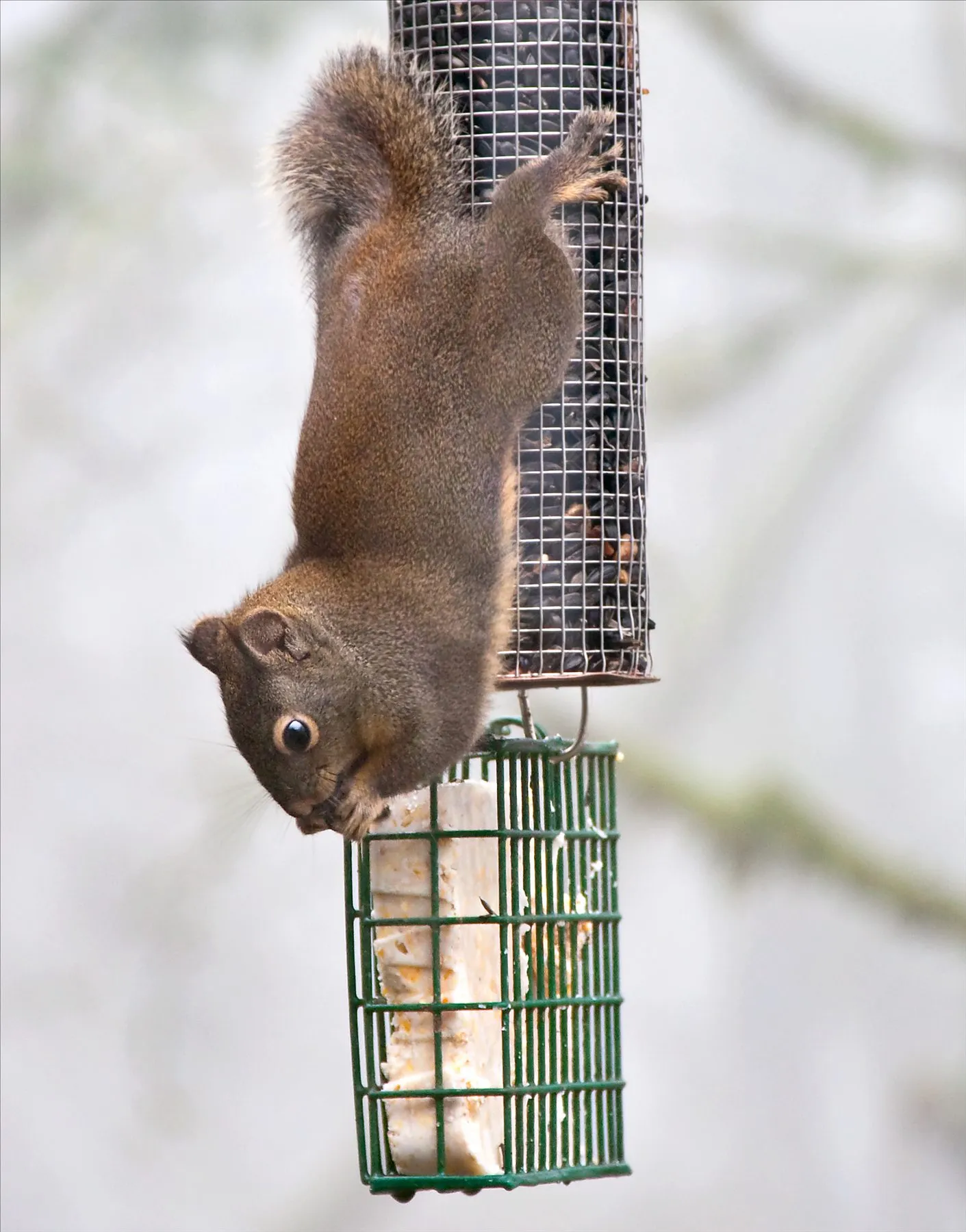
Quick answer: Start with access geometry, not a stronger seed. Put a pole feeder where squirrels cannot jump to it from a branch, roof, fence, or deck, then add a properly sized pole or hanging baffle. Keep the ground clean and do not use poisons, sticky substances, hot-pepper mixtures that can affect other wildlife, or improvised traps.
Remove the easiest route first
Walk around the feeder and identify every launch point. Squirrels can use a nearby branch, fence, railing, shed, or roof as a bridge. Moving the feeder even a short distance may not help if another route remains.
Trim only what you are allowed to trim, and never remove healthy habitat simply to solve a feeder problem. A safer approach is to move the feeder into a clear space and use a baffle designed for that mounting method.
Pole feeders: use a wide, smooth baffle
A pole-mounted baffle works by stopping a squirrel before it reaches the feeder. It needs to be wide enough to prevent an easy leap around the edge and positioned below the feeder, not directly beside it. The exact spacing depends on the pole, the baffle, the feeder height, and the launch points in your yard; follow the hardware maker’s dimensions rather than treating one number as universal.
Audubon’s guidance (opens in a new tab) describes a pole baffle as a setup, not a stand-alone purchase: nearby launch points can bypass it. Check the recommended height and clearance against the actual pole and feeder before committing to the hardware.
Check the pole after installation. A leaning pole, a rough surface, or a branch that has grown into the route can defeat an otherwise sound setup.
Hanging feeders: block the suspension line
Hanging baffles need to interrupt the path from above. A feeder hung under a tree branch can still be easy to reach if a squirrel walks along the branch and drops down. Use a hanging baffle made for that arrangement and inspect the hook, chain, and nearby branches together.
Do not hang a feeder over a place where a falling squirrel could injure a person or damage property. The goal is a harmless change of access, not a dangerous obstacle.
Reduce the reward
Clean up spilled seed and hulls below the feeder. Ground feeding attracts squirrels, rodents, and other visitors even when the feeder itself is protected. Use a tray only if you can clean it regularly, and discard damp or moldy seed rather than adding fresh seed on top.
If squirrels are defeating the feeder, changing the food may help with waste but will not fix a reachable route. Solve placement first, then choose seed that the intended birds can use and that you can keep dry.
When equipment is worth considering
For a freestanding pole with clear space around it, start by checking a pole baffle compatible with that pole. For a suspended feeder, inspect the support and consider a hanging baffle that interrupts the route from above. Where the layout cannot provide enough clearance, a weight-activated feeder may be an option, but its settings and landing surface must still suit the birds you want to welcome. These are purchase criteria, not tested recommendations; no brand or model is ranked here.
Choose the setup by access route
| Your setup | Check first | Non-harmful next step | Limitation to keep in mind |
|---|---|---|---|
| Freestanding pole | Measure clearance from trees, fences, roofs, and other solid launch points | Audubon describes at least 8–10 feet of clearance and a baffle about 4–5 feet above ground for its pole setup; verify against the actual hardware | A baffle cannot overcome a reachable launch point |
| Hanging feeder | Trace the branch, hook, cable, and nearby railing | Use a hanging baffle made for the support and remove the easiest route where allowed | A squirrel may bypass a baffle by dropping from above |
| Balcony, window, or tight space | Identify building rules, railings, and the birds you hope to feed | Favor cleanup and a compatible cage or weight-activated design only after checking access | Cages and weight settings can exclude larger target birds |
Methods to avoid
- Do not use poison or glue traps around a bird feeder.
- Do not place sharp objects, wire, or unstable hardware where wildlife or people can be injured.
- Do not assume a spicy coating makes every seed safe for every animal.
- Do not trap and relocate wildlife without checking local rules and professional guidance.
- Do not promise a squirrel-proof result before testing the geometry in your own yard.
For a feeder that is still quiet after the change, use Why Birds Stop Visiting Your Feeder. Placement principles come first in Where to Place a Bird Feeder.
Sources
Photo credits
The licensed squirrel photograph in the article header is credited beneath it. No product appears in that image.