Quick answer: A female Northern Cardinal is a robin-sized, long-tailed songbird with a tall crest and a short, very thick, orange-red bill. Her body is pale brown, with warm reddish tinges in the wings, tail, and crest. That combination of crest, heavy bill, and brown body with red accents identifies her in much of the eastern United States. In the desert Southwest, check for a Pyrrhuloxia too.
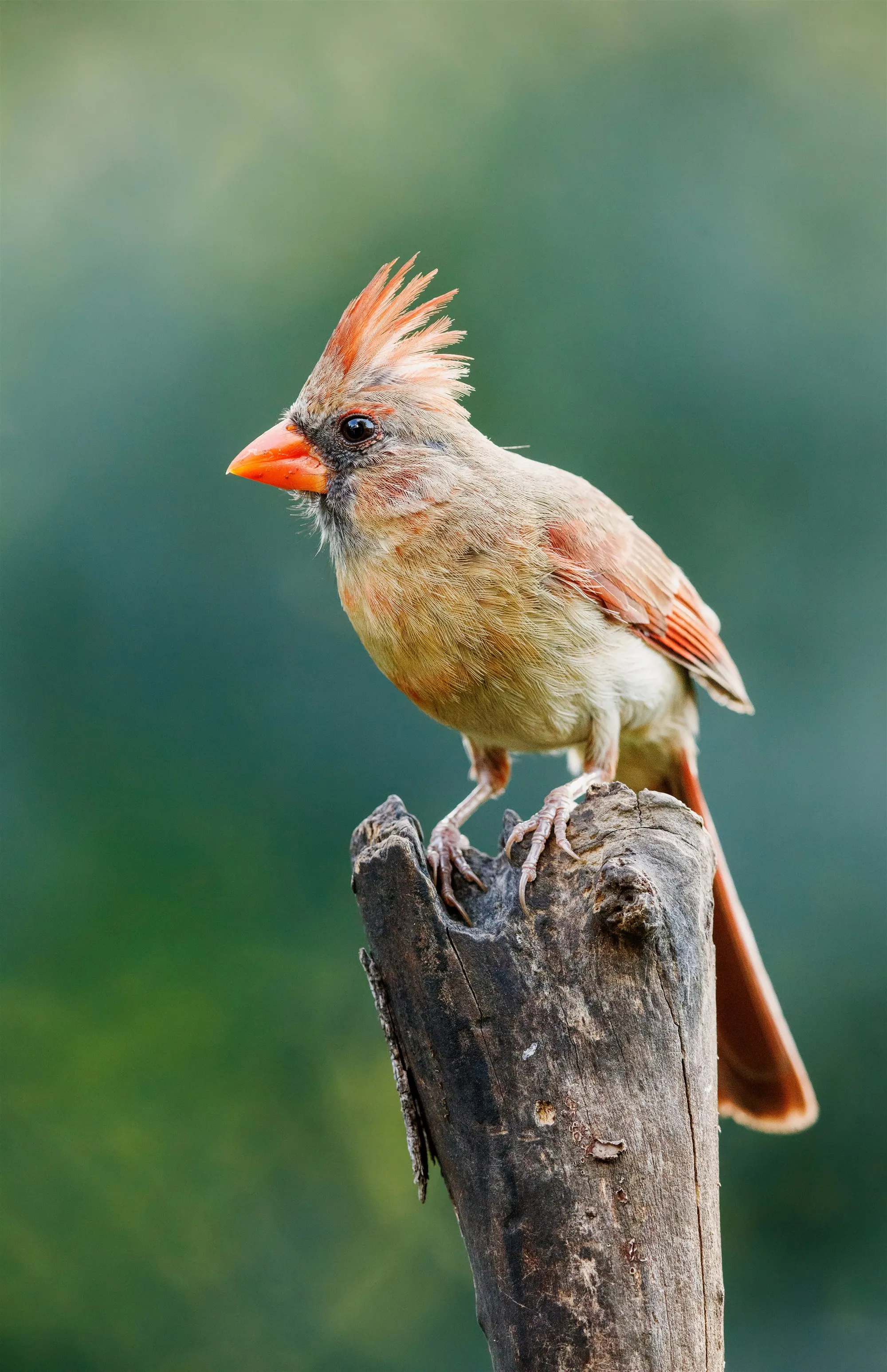
A female Northern Cardinal. Photo: N. Lewis, National Park Service (Shenandoah National Park), public domain, via Wikimedia Commons.
She is easy to overlook next to the brilliant red male, but she has a pattern of her own. Looking for that pattern, not just the color, is what makes the identification reliable.
Five field marks to check
1. Crest. A prominent crest is one of the first things Cornell’s description of the species lists. In photographs it looks taller or shorter depending on posture, so judge it across several views of the bird, not one.
2. Bill. The bill is short and very thick. On an adult female Cornell describes it as red-orange; Audubon’s field guide calls it pink and large. Both agree on the heavy, seed-cracking shape. Expect the color to look different in shade and sun.
3. Body color. Cornell describes females as pale brown overall, with warm reddish tinges in the wings, tail, and crest. Cardinals do not molt into a dull plumage, according to Cornell, so she looks the same in winter.
4. Face. Cornell’s description includes a black face immediately around the bill. In photographs the mask ranges from bold to muted, so treat it as a supporting clue, not a deal-breaker.
5. Size, shape, and posture. Cornell calls the species a fairly large, long-tailed songbird, slightly smaller than an American Robin. Both sexes measure 8.3 to 9.1 inches long, with a wingspan of 9.8 to 12.2 inches and a weight of 1.5 to 1.7 ounces. Cardinals often sit hunched, with the tail pointed straight down.
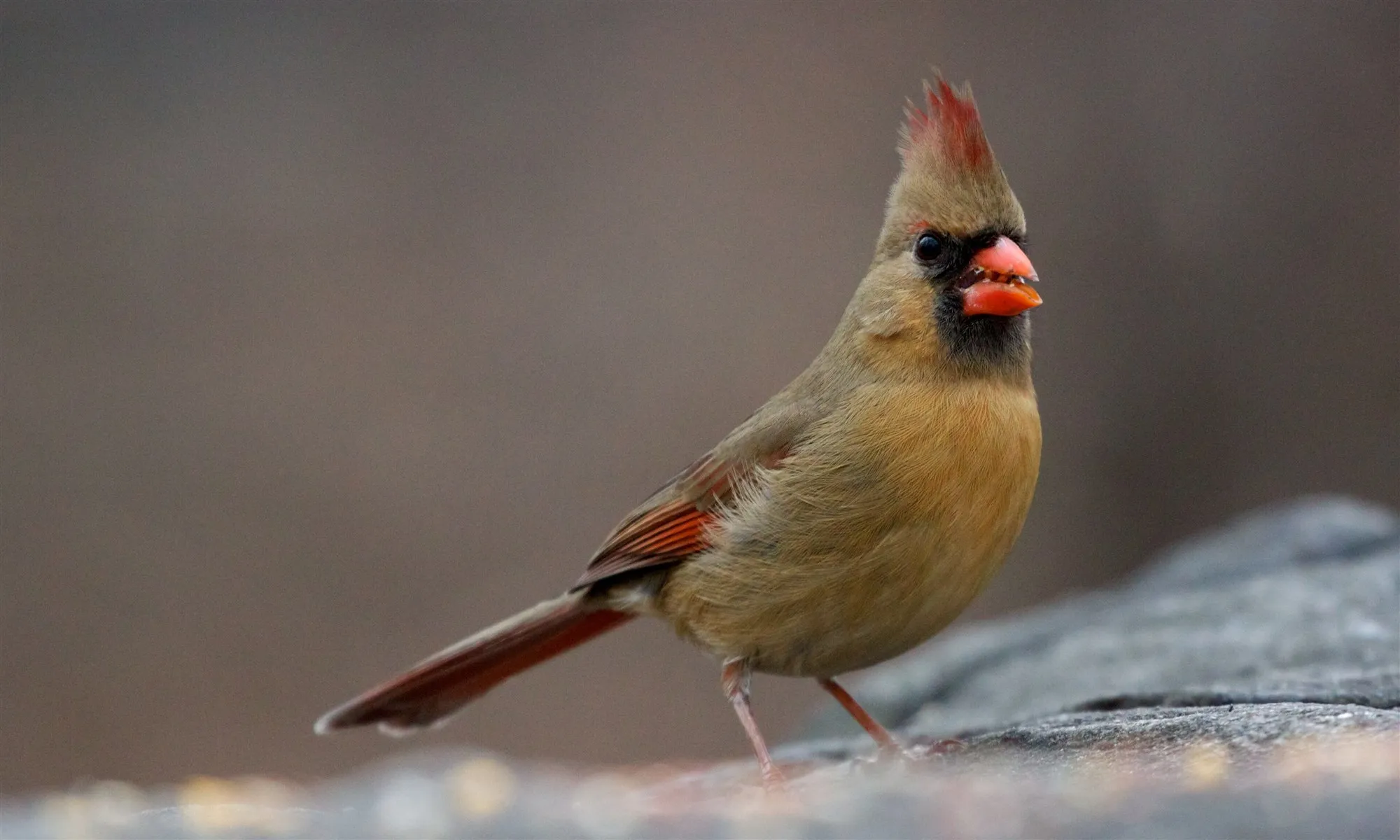
A side view shows the long tail, crest, and heavy bill together. Photo: Matt MacGillivray, via Wikimedia Commons (CC BY 2.0).
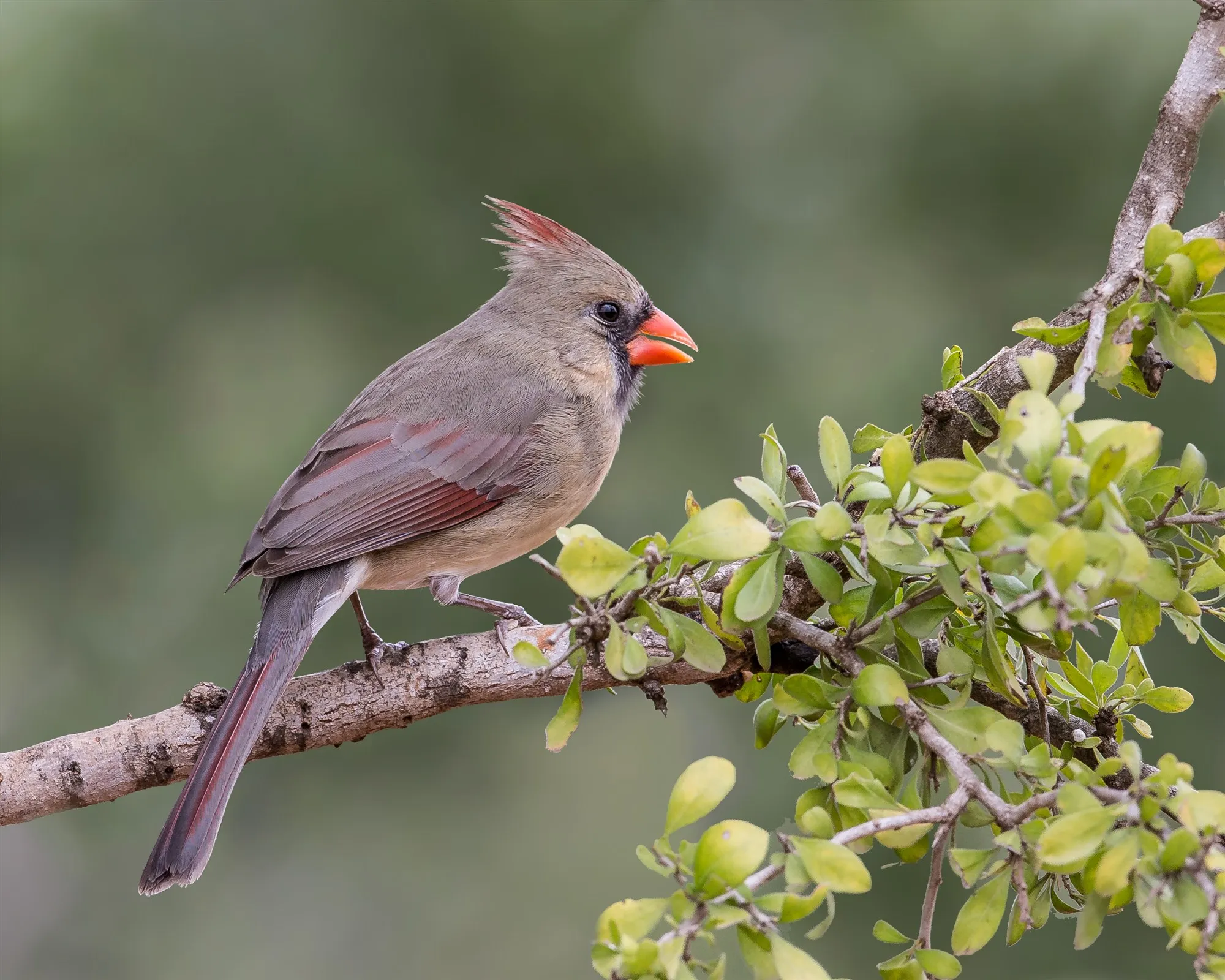
Same species, different bird and light: this female looks grayer, with the same crest, bill, and red tinges. Photo: Andy Morffew, via Wikimedia Commons (CC BY 2.0).
Female versus male
An adult male is brilliant red all over, with a reddish bill and a black face right around the bill, per Cornell. The female is pale brown with red tinges, and Cornell says she has the same black face and a red-orange bill. Both have the crest, the thick bill, and the long tail, which is why they look so clearly like the same bird when they are side by side. Audubon calls the male unmistakable, the only red bird with a crest, while suggesting a comparison with tanagers.
For a compact adult male/female table and the juvenile exception, see Male vs. Female Cardinal. Stay with this guide if the question is whether the brown bird is a cardinal at all; the similar-species section below is designed for that decision.
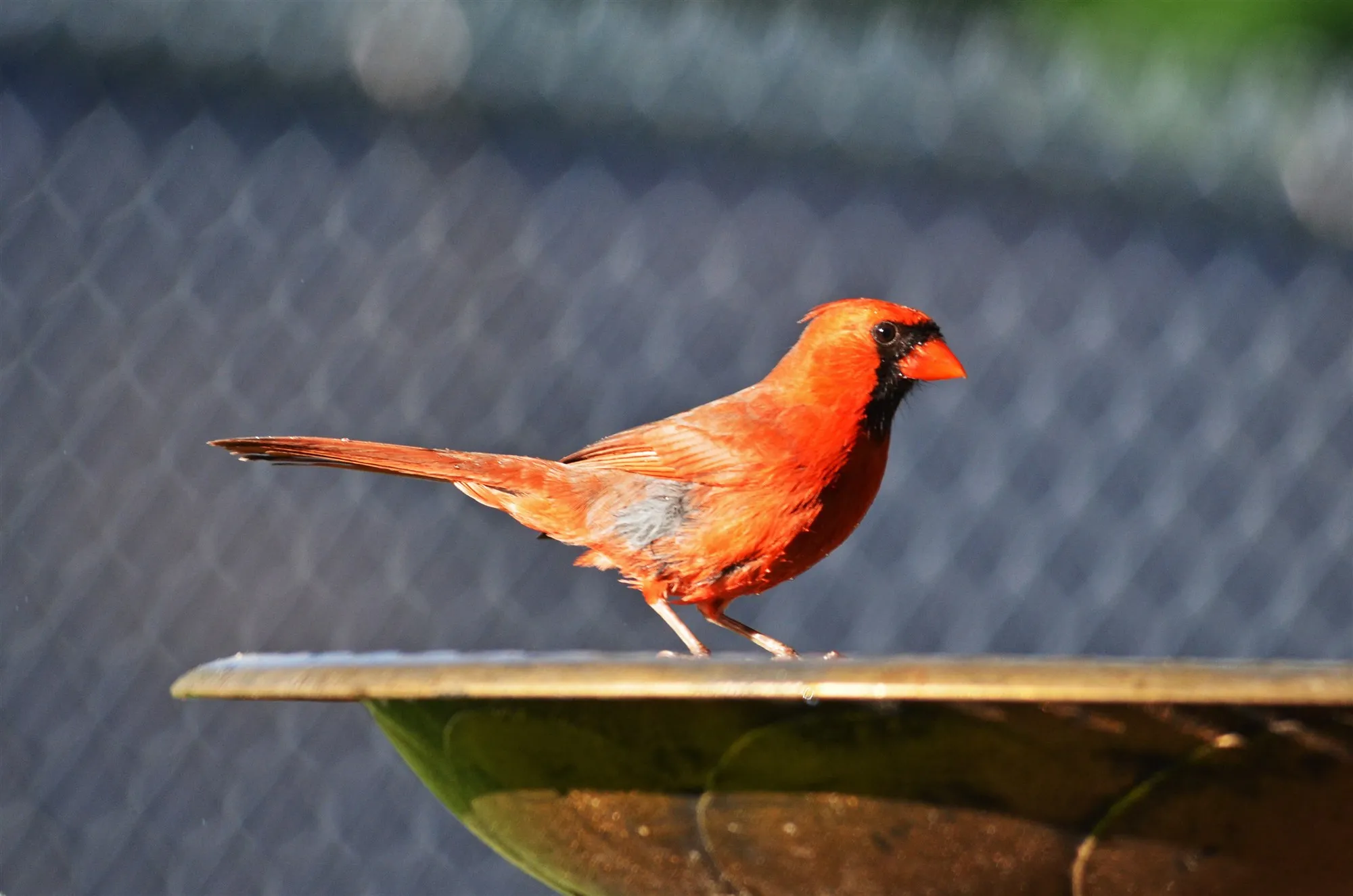
An adult male at a bird bath. Photo: Courtney Celley, U.S. Fish and Wildlife Service, public domain, via Wikimedia Commons.
Young cardinals
A juvenile looks similar to the female but has a gray to black bill, according to Cornell. Audubon also notes the bill is black at first. So a brown, crested bird with a dark bill may be a young cardinal, not a different species.
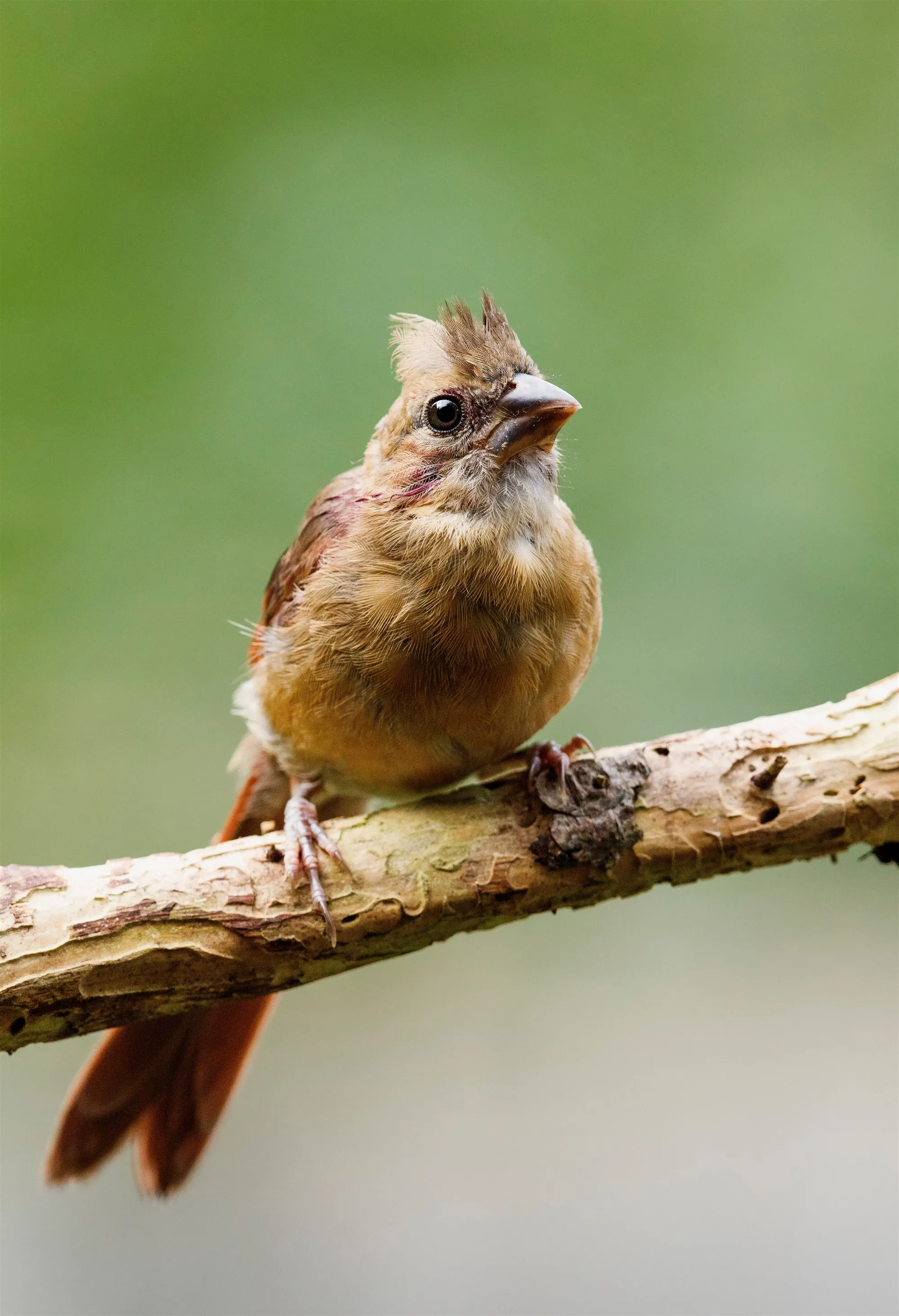
A juvenile Northern Cardinal with a dark bill. Photo: N. Lewis, National Park Service (Shenandoah National Park), public domain, via Wikimedia Commons.
Similar birds
| Feature | Female Northern Cardinal | Juvenile Northern Cardinal | Female Pyrrhuloxia | Female House Finch | Best observation action |
|---|---|---|---|---|---|
| Crest | Prominent | Similar to the female | Longer and more pointed | No crest | Look at the head outline across more than one posture |
| Bill | Short, very thick, red-orange | Gray to black | Stubby and rounded; yellow in breeding plumage, dusky in winter | Conical, stout | Check bill color and thickness, not body color alone |
| Body | Pale brown with reddish tinges in wings, tail, and crest | Similar to the female | Grayer than a female cardinal | Brown with blurry streaks down the belly | Look for plain versus streaked underparts |
| Where | Backyards, parks, woodlots, shrubby edges | Same as adults | Desert scrub, dry grasslands, open mesquite | See Cornell’s House Finch species page | Check habitat and regional range before deciding |
This table is a learning aid. Always compare with several photographs and a regional field guide.
Female House Finch
Both can look brown at a glance. Cornell describes a female House Finch as brown overall with blurry streaks down the belly, a plain brown face, a conical bill, and a notched tail. A female cardinal has a crest and a heavier, red-orange bill, and her underparts are plain pale brown. Streaks and no crest point to a finch.
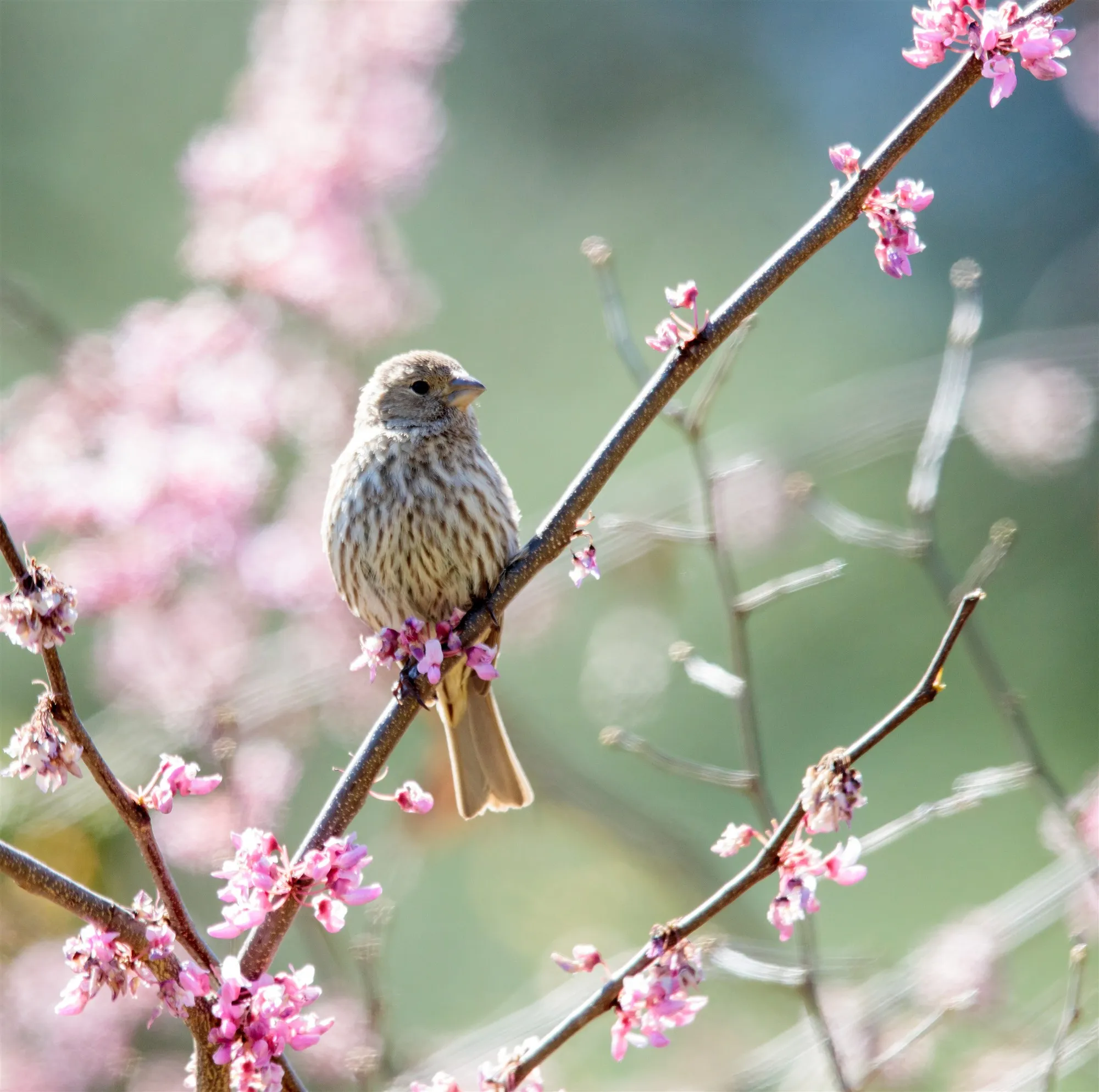
A female House Finch, with the streaking and plain face that distinguish it from a cardinal. Photo: N. Lewis, National Park Service (Shenandoah National Park), public domain, via Wikimedia Commons.
Pyrrhuloxia (desert Southwest)
Audubon advises comparing a cardinal with the Pyrrhuloxia in the Southwest. Cornell says a female Pyrrhuloxia is grayer than a female cardinal, with a longer, more pointed crest, and that its bill is stubby and rounded, yellow in breeding plumage and dusky in winter. A female cardinal is browner and has a red-orange, not yellow, bill. The Pyrrhuloxia is found in desert scrub, dry grasslands, and open mesquite forest.
This guide intentionally keeps that comparison textual until a documentary photo can be retrieved and rechecked. The B7 source record remains in the photo register after an HTTP 429 response; the absence of that optional image does not change the field-mark comparison above.
Female Phainopepla
Cornell’s similar-species page also lists the female Phainopepla. It is much darker overall than a female cardinal and has no reddish highlights, along with a slender bill, red eyes, and white feather edging on the wings.
Common identification mistakes
- Judging by color alone. Individual birds and lighting both change how brown or gray a cardinal looks, as the two female photos above show. Check the crest, bill, and shape first.
- Dismissing a brown, crested bird with a dark bill. It may be a juvenile cardinal.
- Calling every brown bird at the feeder a female cardinal. Streaks on the belly and no crest point to a female House Finch.
- Missing the Pyrrhuloxia in the Southwest. Look for a gray body, a longer pointed crest, and a yellow bill.
- Expecting a sharp black mask on every female. The face mark varies from bold to muted in photographs.
Where and how you will see her
Cornell says cardinals sit low in shrubs and trees or forage on or near the ground, often in pairs, and are common at feeders but can be inconspicuous elsewhere until you learn their loud, metallic chip note. Audubon says they come readily to feeders and favor sunflower seeds. They are year-round residents throughout their range, per both sources. Both sexes sing, and Cornell notes that females sing alone and in duets with males.
If cardinals you used to see have stopped visiting, see Why Birds Stop Visiting Your Feeder. If you are choosing a station for cardinals, Where to Place a Bird Feeder can help with access, safety, and routine care. For broader setup questions, see Bird Feeders; for other field-mark guides, visit Bird Identification.
Confirm it in five questions
- Is a crest visible or suggested by the head shape? A cardinal can hold its crest low, so do not rule one out from this mark alone. Check the heavy bill, plumage, silhouette, and local range together.
- Is the bill short, very thick, and orange-red? If it is dark, think juvenile cardinal. If it is yellow, think Pyrrhuloxia.
- Is the body pale brown with red in the wings, tail, and crest, and plain underneath? If the belly is streaked, think House Finch.
- Is it gray and in the desert Southwest, with a very pointed crest? Think Pyrrhuloxia.
- Is it robin-sized with a long tail? A cardinal fits this size and shape.
If your look was brief, it is fine to leave the identification as “probably.”
Sources
- Cornell Lab of Ornithology, Northern Cardinal: Identification (opens in a new tab)
- Cornell Lab of Ornithology, Northern Cardinal: Similar Species Comparison (opens in a new tab)
- Cornell Lab of Ornithology, Pyrrhuloxia: Identification (opens in a new tab)
- Cornell Lab of Ornithology, House Finch: Similar Species Comparison (opens in a new tab)
- National Audubon Society, Northern Cardinal field guide (opens in a new tab)
Photo credits
- Female Northern Cardinal on a stump: N. Lewis, National Park Service, Wikimedia Commons (opens in a new tab), public domain.
- Female Northern Cardinal, side view: Matt MacGillivray, Flickr (opens in a new tab) via Wikimedia Commons (opens in a new tab), licensed CC BY 2.0 (opens in a new tab). Resized from the original.
- Female Northern Cardinal on a branch: Andy Morffew, Flickr (opens in a new tab) via Wikimedia Commons (opens in a new tab), licensed CC BY 2.0 (opens in a new tab). Resized from the original.
- Male Northern Cardinal at a bird bath: Courtney Celley, U.S. Fish and Wildlife Service Midwest Region, Wikimedia Commons (opens in a new tab), public domain.
- Juvenile Northern Cardinal: N. Lewis, National Park Service, Wikimedia Commons (opens in a new tab), public domain.
- Female House Finch: N. Lewis, National Park Service, Wikimedia Commons (opens in a new tab), public domain.